

Some say cake can solve the problems of the wor
ld. It might sound hyperbolic to those uninitiated, but speaking to Nat Paull from Beatrix Bakes, I could almost believe that cake could be the answer. I mean, it won’t do too well at disarming nuclear weaponry or mediating between waring countries (does this mean that Donald Trump is actually cake?) but, I’m coming to understand, it has a power that can’t be underestimated. More about Nat Paull in a moment.
There is something about talking about food that moves me. Not just because I am salivating at the thought of it and am overwhelmed, but more so that it’s the people who have dedicated their lives to perfecting the act of cheffing it. It surprises me that most often when interviewing chefs I find myself holding back tears. Because food is never just food, it’s at first survival and then comfort and connection. It speaks to our history, it leans into a future and it anchors us to our lands, skies and waters. Food is the ultimate metaphor for our living, for our desires, for our anxieties, it explains us back to us in the same way any good art can. I am adding the dim sim into this articulation of beauty - just so we’re clear.
I haven’t really understood how to imbue any of my cooking with the essence of the world or my feelings about it. I am lucky though, I regularly eat food that has done that, cooked by my partner inspired from his life in Greece. His cooking is soaked in his life and his love. Each time I eat his dishes, yemista, trahana, fasolada and tell him how wonderful it tastes, he looks at me confused, as if I might have offended him and says, ‘well of course, this is how I love.’ On the other hand, I haven’t been taught to love like that, for me it has always been about efficiency. How fast I can whip it together and put it on the table. No love, no life, no leaning into my history.
And as such, I’m not a good cook apparently, or so my ungrateful children tell me. They don’t often tell me directly, but they speak loudly with their sad mournful eyes when I tell them what we are having for dinner. I enjoy cooking, but it’s always been something I’ve done to keep my bear cubs alive, not their palettes. My eldest has described an almost PTSD response to the smell of Dahl, such was my fervour in the winter of 2018. It wasn’t bad Dahl, just excessive. The house we were living in at that time might never recover from that smell that must have made its way deep into the wooden floorboards and stuck to the light fittings and curtains. Working long hours means that repetition is the devil in my kitchen. Bolognese, Dahl, Tuna pie - my children will never come home to ‘mums’ to request meals from their childhood because they are now triggered by them. Instead, they visit psychologists to unpick the trauma of the meals I forced upon them time and time again.
So, as I was saying - cake. I’m not a big sweet tooth so hadn’t considered the impact of cake on the mechanics of the world the way that Nat Paull was describing it to me. She looked at me with her big eyes and said, ‘cake doesn’t discriminate.’ I stared at her for a while, unsure if she was having an episode, but realised quickly that she was serious. After running a successful bakery and releasing successful baking books, Nat is now volunteering and teaching baking to the people that have found themselves likely without their own kitchen to undertake this simple, but meaningful task. They have been welcomed back by her to the unbelievable alchemy of fusing flour, milk, eggs and sugar and creating something that warms the hearts of people you love. Sometimes when we find ourselves in a rough patch, it’s not the getting of love that we yearn for, it’s often the chance to give it.
Nat and I shared one of my favourite moments on radio a couple of years ago. I had asked the audience what got them into a zen state of flow. Was it de-nitting their children’s hair? Or mowing the lawn? Or popping those popping plastic things. And I received a call from Verna who told us, that at the age of 90 (or thereabouts) - it was the act of baking sponges that took her to her happy place. She described the joy of nailing the sponge and then sharing the sponge with anyone who would find themselves on her doorstep. Of course, thousands of people listening in, demanded her recipe. And she kindly shared it. But this is what happened when I replicated that recipe:
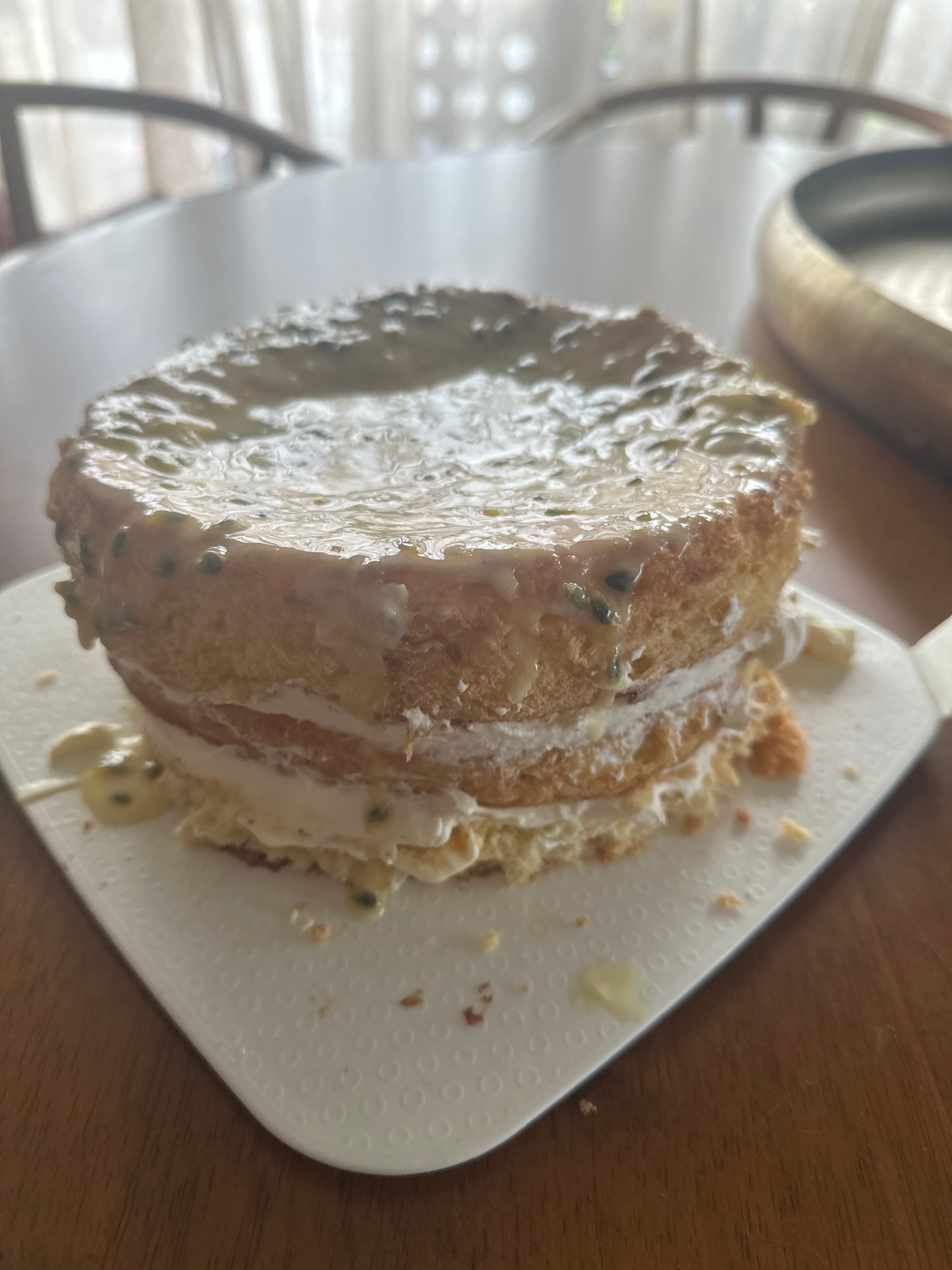
Nat Paull had been following along and had called me to offer to take Verna’s recipe into her lab and decode it for the hack cooks like myself, so we could cook like Verna each and every time. And this is what she emerged with - this incredible deciphered ‘how to Verna sponge.’
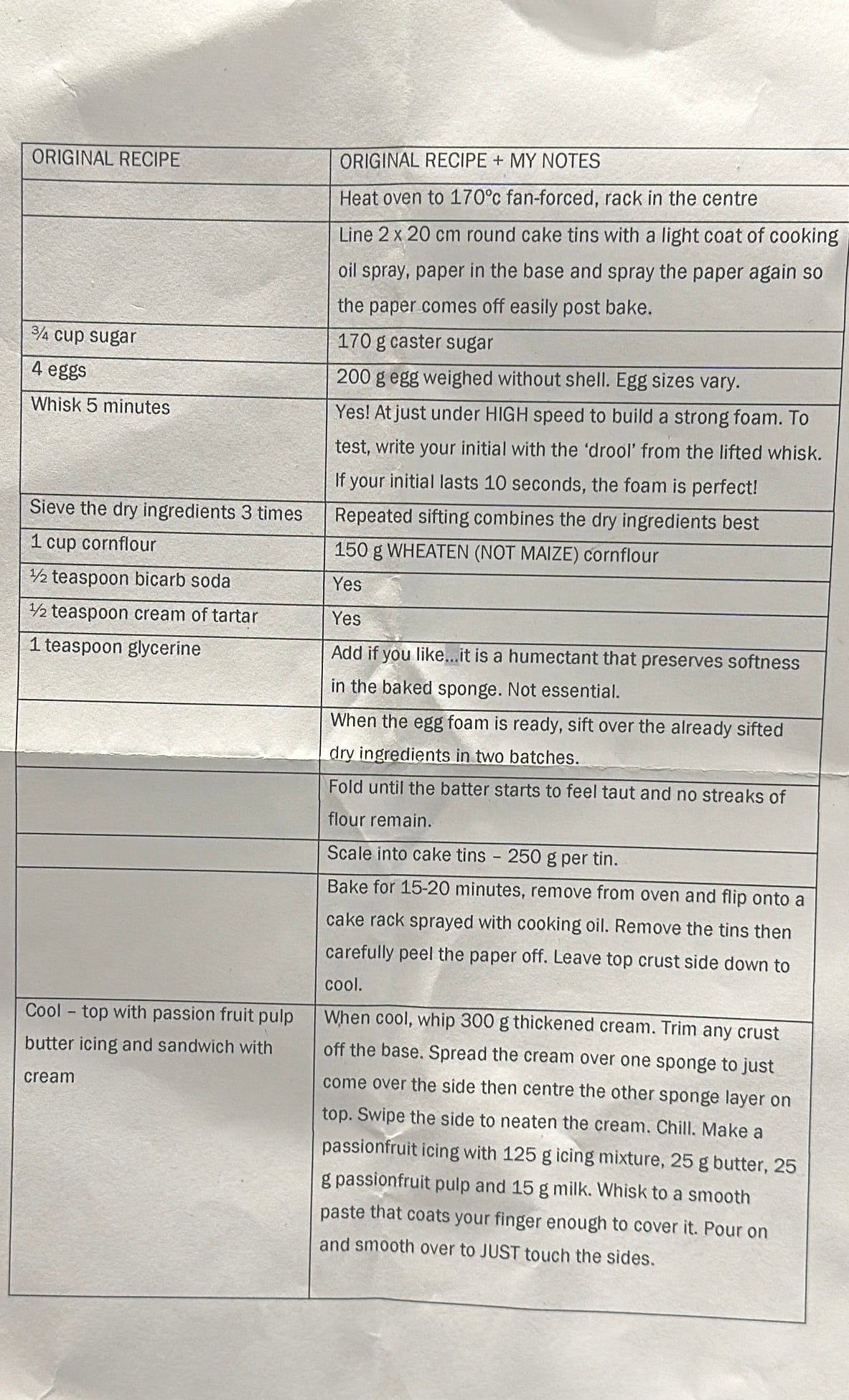
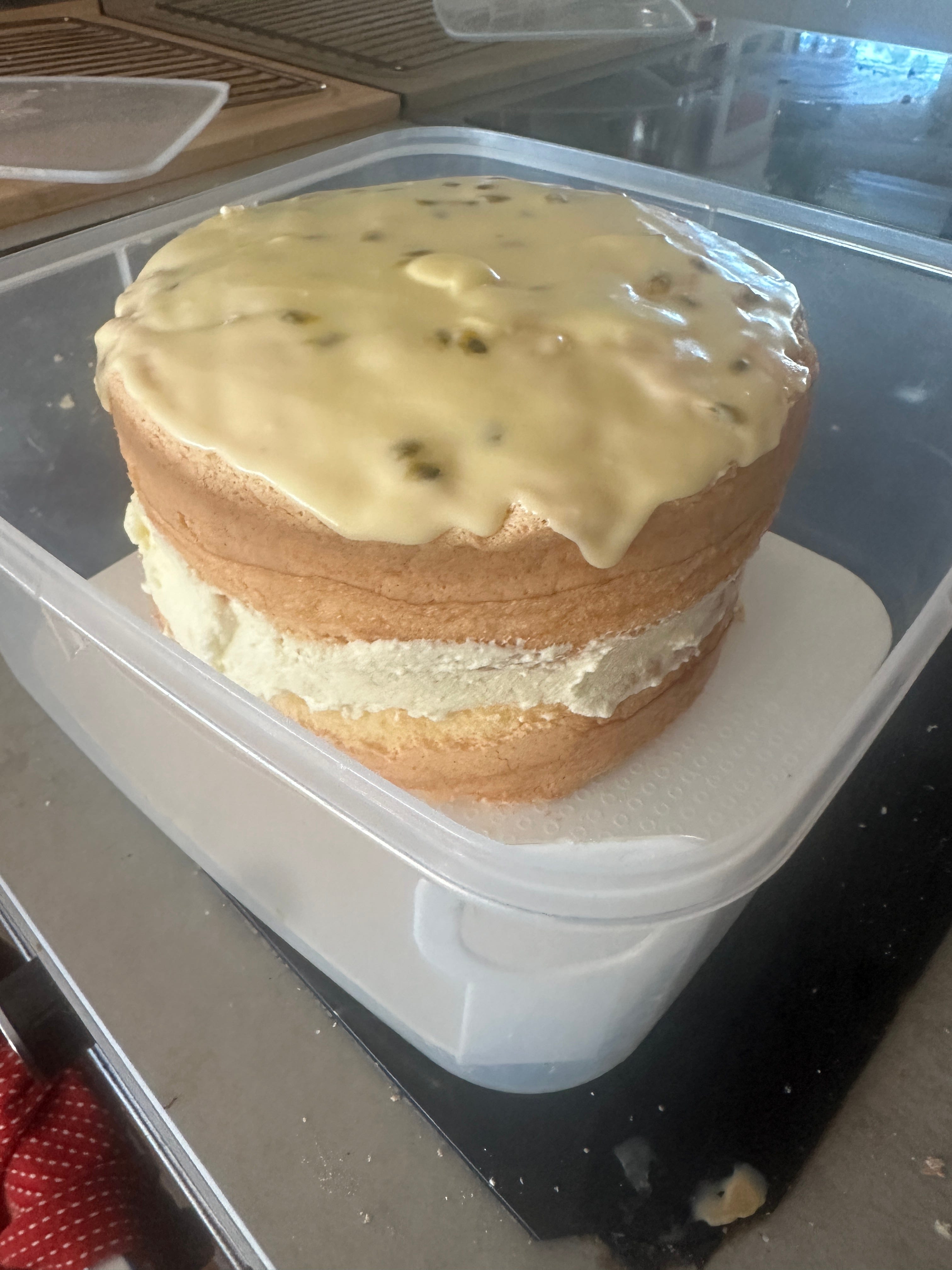
I took this home and NAILED the Verna sponge. And have done so, each and every time since. And I cry every time I make it now. I cry because I can be one of those people who can make a sponge for my children’s birthdays. I cry for the love of Verna and her kitchen, and the hundreds of cakes that she has pumped out of it for the love and the flow of it. I cry because now, there are hundreds of people with her recipe who think about her when they make it. And I cry because of Nat Paull who took the hieroglyphics of an ancient recipe - likely handed down through generations orally - and found a way we could keep it alive. I cry because she’s right, cake doesn’t discriminate but can bind us together with just some flour, eggs and milk and maybe a bit of sugar, and answer the questions we seldom know we’re even asking
.
Thank you Verna and Nat xx
Oh Madeira Jacinta! I remember back zen to that cake as it got baked over the airways. Everyone chimed in as bakers ... and you learnt to speak in the 'vernacular' by birthing that first spongerific torte. Your second attempt with Nat the cake whisperer was triumphant. I am happy for you and all the passionfruit birthdays to follow. But in all honesty, I shall always favour your imperfect first cake baby. Made with passion. Do not expunge.
Cake, in this House, is a kind of prayer. Not the kind with clasped hands or sanctimony, but the kind muttered under breath while licking the spoon. A quiet liturgy of butter & burnished edges. Cake doesn’t need a reason. It just arrives—sometimes slightly lopsided, sometimes still warm, always sure of its welcome. It doesn’t ask questions. Doesn’t judge the state you’re in or whether you’ve cried into the batter. It simply sits there, whole & soft, waiting to be chosen. Some say it can’t save the world—but I’ve seen it come close. I’ve seen it placed at bedsides, offered after apologies, sliced into silence. I’ve eaten cake that tasted like the first moment I exhaled after heartbreak. I’ve made cake that held every sorry I didn’t know how to say. There are cakes I still dream about. Cakes that forgave me. Cakes that forgave them.
I’m not a baker. I’ve burned things I wasn’t even cooking. But I know the shape of a cake that was made with love. You can tell. It leans slightly to one side, like it’s listening. It holds. It remembers. We don’t serve cake in this House. We offer it—slice by slice, to those who’ve survived the day. And if it crumbles? So be it. So do we. Everything sacred does