Killing Hope - The Pledge to Tear Up Treaty
How the colonial mindset is alive and well in the lead up to the Victorian election.
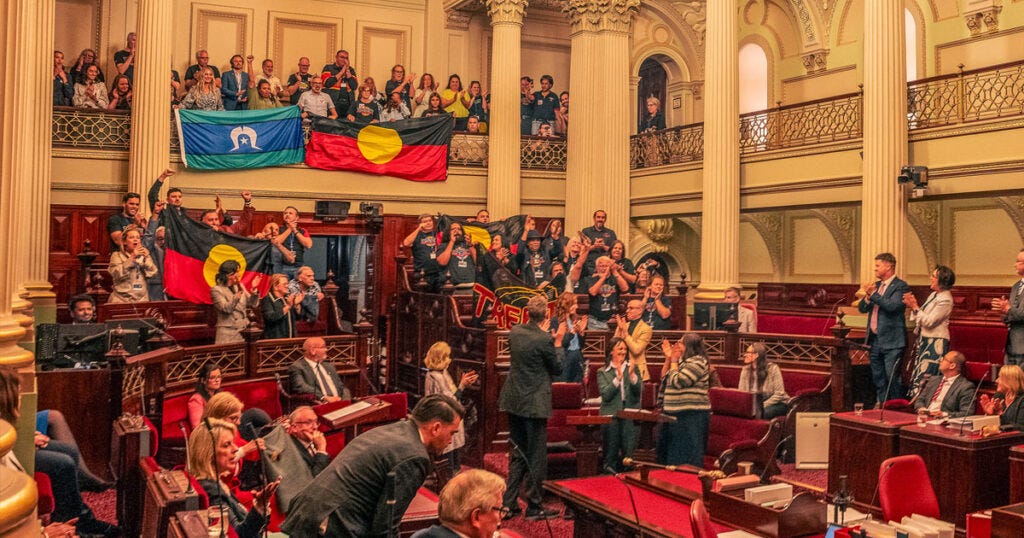
It’s the tears I remember. The gentle percolation of happiness, sorrow and the memory of those who deserved to see what’s been achieved here but aren’t here to share in the moment. The opportunity it promises for a people that have defied our predicted demise for generations. The celebrations and hugs, so perfect in the moment, gently broken by the realisation that the real test, and all the hard work to ensue, is yet to come.
There were many such moments in the ten years it has taken to formally get this point through the toil and dedication of hundreds of people, from all backgrounds, to bring an idea to life.
Before the formal work began, the ambition for truth and treaty existed since the earliest days of invasion. To have a formal understanding between nations, based on mutual respect. To enrich all through shared practice, the exchange of customs and the transfer of knowledge between two cultures that couldn’t be less alike but could be wise enough to recognise our shared humanity.
Throughout the history of this place now known as Victoria, there have been hundreds of moments where that kind of cultural enrichment could have been etched. But the colonial mindset, for a myriad of reasons, some known, some unknown, couldn’t bring itself to reach out.
Most attempts to learn our ancient languages and customs were undertaken in the earliest days of encroachment, before reinforcements with their sheep, cattle or gold pans arrived to transform all before them. Once the colony had transported and then transplanted itself on Aboriginal land, the curiosity about the ways of the “conquered” vanished.
It’s that mindset, with lashings of rank opportunism, that sadly still prevails today. It means we’re at yet another nexus, on the verge of yet another opportunity lost, as the Liberal and National parties pledge to tear up Treaty within their first one hundred days in office, IF elected.
It’s a pledge that plays well to certain sections of the electorate. “Why should they have something that we don’t,” was the transactional message that cut through the Voice debate so effectively and threatens to do the same in the lead up to November 28, the day Victorians go back to the polls.
There are so many pressing issues to be dealt with in this state. Cost of living, a teetering hospital system, housing stock and crime to name just a few. Problems that need to be approached with clear minds, sound policy agendas and political actors that can think beyond the media cycle. But we’re well past that point now.
For decades, modern politics has been too far removed from the lived experience of the real world. The petty undergraduate politics that’s carried on the back of political staffers as they metamorphise into ministers of the Crown, does more than permeate the halls of power; it dresses and re-decorates. It means that when you have a politick bereft of ideas and imagination, beyond the lust for the perks of power, that truth and treaty become easy targets in the absence of policy, something to talk about.
Afterall that’s what’s really at the heart of the culture wars. A strategy to divide the electorate in the hope that the resulting division will fall on your side of the electoral ledger.
It has become an industry in its own right. There are millions of dollars through groups like Advance that will fund the anti-Treaty campaign over the coming months. There are waves of disinformation and malinformation to come, that will look to plant the seeds of division in communities and family units across the state. Hate sites that get their oxygen at the bottom of cesspools like Facebook are spraying falsehoods all over the site, waiting to find a prejudice or two to stick to in an age of perpetual grievance.
The apparatus built to help sink the Voice not only still exists, but it’s also more refined. AI was barely in the public domain during the Voice debate, now it’s in the hands of every wannabe political operative either paid or unpaid.
This battle is nothing new. We’ve been speaking about it and preaching against it for generations. As was the case in March 1930 when my great grandfather Shadrach Livingstone James wrote in the Melbourne Herald, “The whole attitude of the white man towards the aborigine has all along been to dispirit and humiliate him, to extinguish his self-respect, to suppress his ambition; in short, to kill his hope.”
That’s what destroying the treaty for a few mangy votes would do. To kill the hope of another generation of Aboriginal Victorians who were prepared to stand-up and work with government for the betterment of all.
We can resist it. Report false information whenever you see it. Rebut attacks on Treaty as nothing more than a distraction from the wave of issues impacting everyday people.
Write to your local MP and let them know that there are people who believe in Truth and Treaty. While you’re at it, perhaps drop your federal member a line to demand truth in political advertising laws, laws that should extend to social media.
You could send sceptics in your own orbit a copy of Truth Be Told, the history of colonial Victoria and its impacts of First Nations peoples from an Aboriginal perspective for the first time, thanks to the Yoorrook Justice Commission.
As I write this, word has come through that a newly minted First Peoples’ Assembly of Victoria has been elected. A large part of this will be theirs to navigate. But they won’t be able to do it alone, because the brutal reality of electoral math has never been an ally of First Nations Peoples.
It will be a test as to whether things move forward, or whether we regress. If there is to be progress then it must be all shoulders to the wheel.
The importance of alliances and allies no matter their background is what will be required here in 2026 just as much as they were in 1930, as Shadrach wrote, “It is gratifying to note that another gracious and courageous friend has stepped into the arena to fight our battle.
The article on this question, which appeared in The Herald on Saturday [22 March 1930] is a momentous one, and will, undoubtedly, lead other sympathetic friends to do likewise and expose the injustice and wrongs under which my poor, helpless, downtrodden people are being hustled into an untimely grave.”
This time we must be the hustlers and not the hustled.