After the Apology
The real test is about to commence
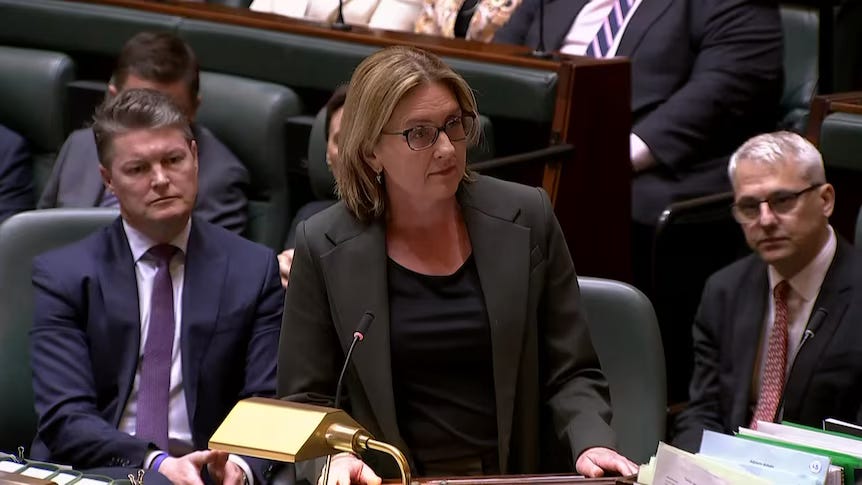
This week, the Premier stood on behalf of the state of Victoria as the first act of Treaty, and offered an apology of a different order, not the first spoken in this place, but the first to name the state’s own violence and tether it, unmistakably, to what must follow.
Sitting up in the gallery with Elders and variations of the distinguished, under the glare of old lights, looking over a chamber of royal green, I listened as the Premier stood and named the thing so many of our old people never lived to hear a government acknowledge that what happened here was not an accident or an unfortunate misunderstanding, but a rapid and violent colonisation carried out by design.
Laws were written in the dark cavernous rooms of parliament to take our land, our languages, our children, our future. They called it “progress”. While I was in the gallery, down below in Queen’s Hall many more had gathered from across the state to watch on a large screen.
The apology spoke of actions and inactions. Of decisions made from where the Premier stood, that criminalised culture, broke up families, erased language and insisted it was all for our own good. It was framed, as it should be, as an act of reckoning, one that belongs not only to Aboriginal people, but to everyone who calls this place home.
I recognised turns of phrase as they landed. Certain combinations of words I’d carried around on scraps of paper for months. Little arguments over commas and cadence that had taken place in anonymous meeting rooms suddenly echoed off the chamber walls. Hearing those lines spoken aloud, on the record, into history, was both surreal and strangely ordinary. It felt less like authorship and more like witness: one small part in a long relay that began generations ago.
Earlier, smoke rose from the ceremony on the steps, briefly softening a building better known for authority than grace. Inside, mob from across the state filled the public gallery and Queen’s Hall, shoulders touching, faces set, the white of eyes glazed in memory. Some wept quietly. Others stared straight ahead, carrying the quiet weight of lives spent waiting for the state to finally catch up with what they had always known. Anyone deriding the motion as performative, deaf to the gentle sobs and warm tears of those present and across the state.
Behind every person in Queen’s Hall and the gallery stood whole communities. Lake Tyers, Framlingham, Cummeragunja, Mooroopna and beyond, and behind them, generations who never lived to hear a parliament speak the words “we are sorry” in full view of the truth they had always carried.
Their dignified and graceful presence was a reminder that the apology did not fall from the sky.
It came because the First Peoples’ Assembly insisted truth and treaty had to be more than slogans. It came because Yoorrook has spent years brushing the dust off the colony’s paperwork and placing it next to the living testimony of our people, revealing a pattern of harm so relentless that no honest government could look away forever. It came because aunty after uncle after cousin stood up and spoke truths that exacted a personal cost, so that those who follow might be spared the burden of having to speak them again.
An opening, not a full stop, the first act of Treaty. It commits the parliament to truth, to the work that follows, and to us, binding the naming of past harm to the task of negotiating a different future under law.
That promise, however, was not shared by everyone in the room. The apology in form of motion was not passed unanimously 56 - 27. Although the 27 will be forgotten in time, the moment won’t be forgotten for its pettiness and the meaness of spirit in which the vote was forced. Would that have happened for an apology to any other section of society?
Before the unifying moment was forced to a vote, the most recently anointed opposition leader Jess Wilson, chose to mark the moment by reaching back to a familiar episode in Australia’s reconciliation story: John Howard’s address to the Australian Reconciliation Convention in Melbourne in 1997. It was there that Aboriginal delegates stood and turned their backs on a Prime Minister who refused to apologise, who spoke and then shouted of ‘blemishes’ instead of violence, and who was already sharpening the edges of his culture war from the lectern.
Hearing that episode invoked again, decades later, on the day of an apology, was jarring. Not because the history of the 1997 Reconciliation Convention was contested, but because invoking it at all revealed a thin and incurious reading of the struggle it represented.
Read from the page, Howard’s words were treated as benign — as if describing invasion and erasure as a mere “blemish” were sufficient to explain, or excuse, the attempted destruction of Aboriginal culture. Recalled in this moment, as the state formally named its own violence, the reference felt less like historical context than a reminder of how easily truth is softened once it is detached from its consequences.
That misreading of history did not end with the speech. It bled into the present. The room held the weight of a parliament speaking the language of repair while defaulting, almost automatically, to punishment. The apology came just a week after laws driven by the slogan “adult time for adult crime”, repackaged as “adult time for violent crime”, cleared a path for children as young as 14 to be treated as adults.
The sequence tells its own story: remorse for past harm sitting alongside decisions that will again fall hardest on Aboriginal children, despite overwhelming evidence that punishment does not create safety, only deeper damage.
One grows tired of restating the numbers. Aboriginal children are vastly over‑represented in detention not by chance but by design — the predictable outcome of generations of policy that criminalised poverty, culture and survival. Yoorrook has named this repeatedly, in Yoorrook for Justice and The Truth Be Told, setting out how the justice and child protection systems continue to reproduce past harms and calling for clear remedies, including lifting the age of criminal responsibility to 14 and treating prison as a last resort for children.
Instead, the government points to raising the age from 10 to 12 as evidence of progress, even as it advances laws that will push 14 and 15‑year‑olds into adult courts and prisons, repeating the familiar pattern of apologising for historic harm while recreating it in the present.
For those kids, the difference between an apology and a sentence is not rhetorical.
An apology backed by treaty, by properly resourced community-controlled services, by housing, health, education and cultural programs that actually belong to mob, could bend the arc of their lives toward something else. A sentencing regime that treats them as disposable adults at 14 will bend it toward the same old destination: cells, courts, cementarties.
The government wants to have it both ways. It wants the moral authority of truth-telling without the discomfort of changing the systems truth exposes. It wants the photo of the Premier standing alongside Elders in the smoking ceremony, and it wants the front page that says she is “tough on youth crime.” It wants to close the gap while widening the net.
There is still time to choose differently.
If this apology is to mean what it says, its measure will not be found in the sound of the room, but in what follows after it empties. It will be measured in whether this parliament can bring its laws into alignment with its language. Whether it is willing to act on what truth has already made undeniable: that justice for our kids means lifting the age, implementing Yoorrook in full, and letting go of the dangerous fiction that punishment can repair the harm the state itself has caused. Anything less is not reform. It is repetition.
Last week, Victoria apologised to First Peoples for the harm inflicted by the actions and inactions of the state and the colony that came before it. Today, the same state has a choice about whether it will keep inflicting that harm under a different name.
This year has already recorded the highest number of Aboriginal deaths in custody since records began in 1979, a grim reminder that the violence of the system is not confined to the past, but active, present, and lethal as ever. Set against that backdrop, the apology does not close a chapter so much as expose what remains unresolved.
Still, this hard fought cathasis and wellspring of emotions whact with it, It to our old people, to those who fought for it and those who never lived to hear it. The consequences of this moment have not yet been written. Whether Treaty has arrived too late for some, or just in time for those who come next, will be determined not by the majesty of the words spoken this week, but by what the state chooses to do now.
What happens next will decide whether this moment is remembered as a turning point, or just another set of carefully chosen words spoken over the sound of doors closing on our kids.


Wholeheartedly agree, James. And Daniel, as ever: compelling and incisive.
I think it’s incredibly graceful for Daniel to say we will eventually forget the 27 members who voted against this. Sure, eventually we will, but in the short-term we absolutely shouldn’t. We should name them, shame them and then punish them at the next elections.
Here’s the list of the 27 Victorian MPs who voted against the Apology to First Peoples motion last week, with their political party affiliations (drawn from the official Legislative Assembly division and member records). It’s not even a pattern, it’s exclusively the liberals and the nationals:
1. Brad Battin — Liberal Party (MP for Berwick) 
2. Jade Benham — The Nationals (MP for Mildura) 
3. Roma Britnell — Liberal Party (MP for South-West Coast) 
4. Tim Bull — The Nationals (MP for Gippsland East) 
5. Martin Cameron — The Nationals (MP for Morwell) 
6. Annabelle Cleeland — The Nationals (MP for Euroa) 
7. Chris Crewther — Liberal Party (MP for Mornington) 
8. Sam Groth — Liberal Party (MP for Nepean) 
9. Matthew Guy — Liberal Party (MP for Bulleen) 
10. David Hodgett — Liberal Party (MP for Croydon) 
11. Emma Kealy — The Nationals (MP for Lowan) 
12. Tim McCurdy — The Nationals (MP for Ovens Valley) 
13. Cindy McLeish — Liberal Party (MP for Eildon) 
14. James Newbury — Liberal Party (MP for Brighton) 
15. Danny O’Brien — The Nationals (MP for Gippsland South) 
16. Michael O’Brien — Liberal Party (MP for Malvern) 
17. Kim O’Keeffe — The Nationals (MP for Shepparton) 
18. John Pesutto — Liberal Party (MP for Hawthorn) 
19. Richard Riordan — Liberal Party (MP for Polwarth) 
20. Brad Rowswell — Liberal Party (MP for Sandringham) 
21. David Southwick — Liberal Party (MP for Caulfield) 
22. Bridget Vallence — Liberal Party (MP for Evelyn) 
23. Peter Walsh — The Nationals (MP for Murray Plains) 
24. Kim Wells — Liberal Party (MP for Rowville) 
25. Nicole Werner — Liberal Party (MP for Warrandyte) 
26. Rachel Westaway — Liberal Party (MP for Prahran) 
27. Jess Wilson — Liberal Party (MP for Kew)