The Deaths of the Schoolgirls of Minab
What modern war does to language, and to accountability.
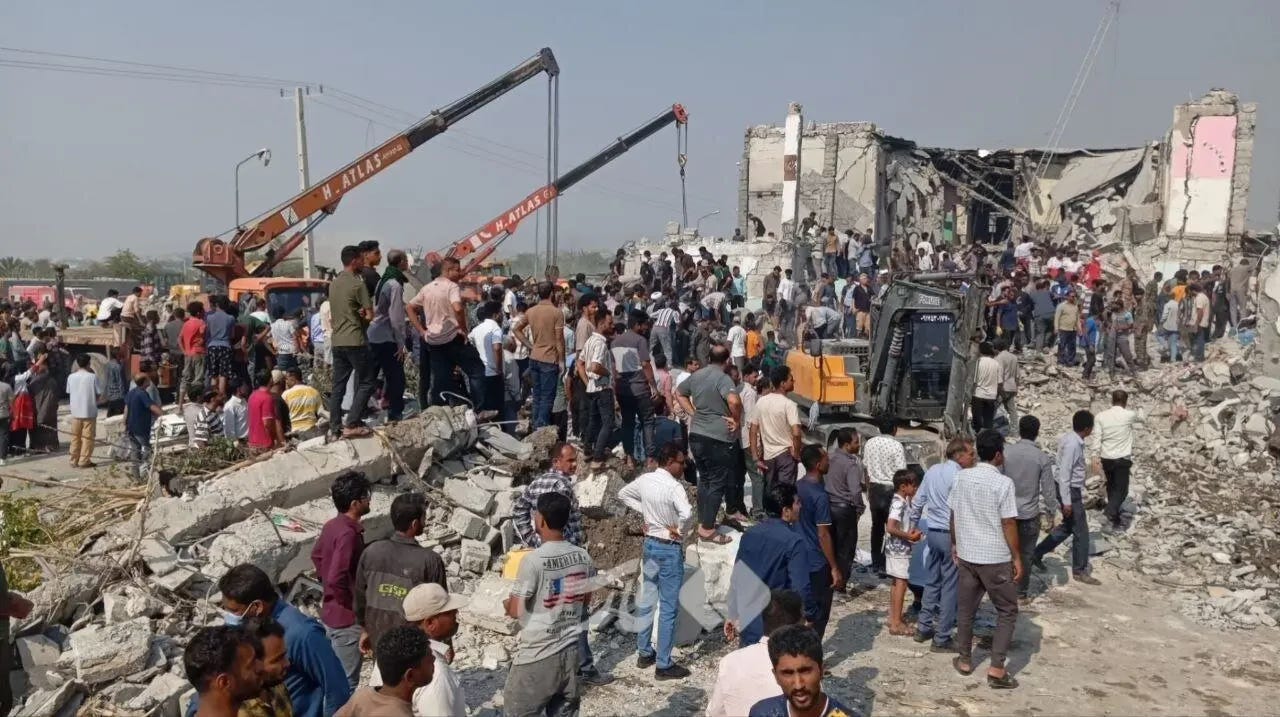
We may never know what really happened, who was responsible. We may never see anyone held to account, accountability itself feels like a relic. What we do know is this: one hundred and sixty-five, mainly young schoolgirls, were obliterated in the southern Iranian port city of Minab, near the narrow throat of the Strait of Hormuz.
The number, 165, tries to pass as information. It is precise enough to quote and distant enough to survive the evening bulletin. It slides across screens between footage of shock and awe, between graphics and commentators endlessly proselytising as perpetually as war itself has become.
The attack that killed the children came mid-morning. Classrooms were full. The girls were leaning into lessons meant to carry them across the decades to come. Somewhere, probably hundreds, perhaps thousands of miles away, someone stared into the blue hue of a screen and pressed a button that ended their lives. We know what happened to the girls. What about the person who pressed the button that started the chain reaction that led to their demise?
Did he or she clock off and go for a drink, return to barracks, sit in a mess hall and recount the day as if it were routine, another entry in a logbook of sanctioned violence? Did they feel even a gram of sorrow for the lives they had snuffed out, pause to consider the ramifications, holy and unholy, of what they had done?
Do they know that the coordinates they had been given resolved into a classroom, that abstraction became intimacy. That dozens upon dozens of young lives ended before those children had the language to name what was happening to them.
Did they speak with clinical pride for completing their operation when they debriefed to their commanding officers. What will the overall assessment be of the targets hit and missed, the potential flaws in intelligence that saw almost the entire Iranian leadership surgically vaporised in a pinpoint strike, but couldn’t point weapons of mass destruction far enough away from Shajareh Tayyebeh girls’ primary school, its students and their open books.
Between the strike and the statement, between the blast and the briefing, there is a silence where the human cost briefly exists before it is translated into language fit for broadcast. It is in that silence that the truth of what happened lingers briefly, raw and unprocessed, before being absorbed into the machinery of war.
Modern war rearranges language before it rearranges landscapes. Civilian casualties. Collateral damage. Target proximity. Words laid down like gauze over something that refuses to be dressed. The media loops the spectacle of impact, the bloom of light against night sky, destruction filmed from a safe distance. The bodies of obliterated children rarely make the edit; saved for the less curated world of social media, a place where it is almost impossible to tell reality from fiction in words, motion pictures or in stills.
While we’re distracted, spin doctors and PR merchants will already be at work, crafting variations of “the engagement resulted in collateral damage, including non-combatant fatalities” or “non-combatants were reportedly among the casualties”.
The official statement from US Central Command was as clinical as expected: “We are aware of reports concerning civilian harm resulting from ongoing military operations. We take these reports seriously and are looking into them. The protection of civilians is of utmost importance, and we will continue to take all precautions available to minimise the risk of unintended harm.”
How long did it take to workshop those words? Words designed not to inflame but to anaesthetise. Words meant to drain anger of oxygen.
We have grown accustomed to watching war as weather, fronts shifting and screens glowing red and amber while children die in Gaza, in Sudan, in Ukraine and in other corners of the world where civilians are caught beneath the machinery of conflict and we scroll, absorb, and move on.
Perhaps it is not the violence alone that should terrify us, but the ease with which repetition smooths its edges, how dopamine and distraction dull whatever reflex for empathy we once claimed as proof of our humanity. Is this the quietest catastrophe of all, that the deaths of the girls of Shajareh Tayyebeh Girls’ Primary School dissolve into background noise in 2026, outrage flickering briefly before fading back into the endless murmur of ordinary life. Switched off when we switch off our devices.
Perhaps this is where accountability evaporates, not at the launch site or in the operations room, not even at the press conference where language is trimmed until it resembles something humane, but as it rises up the chain, thinning as it climbs through ranks and committees and cabinets. By the time it reaches the summit it has hardened into strategic necessity, signed in ink that will never touch the rubble it created.
There is always a chain, forged link by link in quiet rooms where briefings are prepared, intelligence weighed and risk translated into acceptable loss. Each operative along it can point to parameters and doctrine and say he merely operated within the authorised scope of conflict, their part small enough to feel defensible. By the time the order reaches the hand that presses the button, responsibility has thinned into abstraction, dissolved so completely into process that no one feels its full weight. Dissonance through design.
Up the chain sit the old men. Some decorated, some disgraced but in power, certain of their place in history. At the very top sit men nearing the ends of their own lives, speaking of legacy and deterrence and strength while other people’s daughters are buried. They will not see the decades stolen from those girls, they will not sit in classrooms that remain empty. They will not hear the silence that settles over family tables in Minab, where chairs sit empty and questions go unanswered.
They speak of escalation as if it were weather, of proportional response and unavoidable consequence, as though history were a climate system beyond their control. They have lived long enough to trust in the inevitability of their own judgement, to believe that time will sand down the splintered edges of what they authorise. They tell themselves they will be remembered as steady hands in turbulent times, not as the architects of silence in the rubble of classrooms.
Somewhere beneath the medals and motorcades there must be a reckoning that no communiqué can soften. When the lights dim and applause fades, when the body weakens and the room grows quiet, stripped of ceremony, will they think of the names they never learned, the lives reduced to briefings and bullet points. Will they see, even for a moment, the faces of children whose deaths were carried upward through their chain of command and signed into history beneath their authority.
When they lie in their final hours, stripped at last of office and title, will the language of strategy still hold. Or will the image of a classroom in Minab, open books frozen mid-lesson, rise unbidden in the dark and remain, waiting, long after every speech has fallen silent.


My heart breaks for those families who have lost children in this horror. I am grateful for your words that at least give them the dignity of honouring their memory before the world moves on to another day of destruction and death.
A powerful piece that lays bare the reality of alleged modern conflict: A process that extracts humanity from the equation and substitutes platitudes instead.
Will those aging men come to terms with so much of what they’ve thought and done when faced with their own mortality? We’ll never know and they’ll never tell us.