The Exhaustion of Being the Content
The quiet labour of First Nations people during racist controversies.
The land of the Ngunnawal and Ngambri peoples is a beautiful place. A century of reordering the landscape, to make it symmetrical to the human condition, to plant order where European eyes could see none, has failed to tame the natural beauty of the panoramic country cradling Canberra.
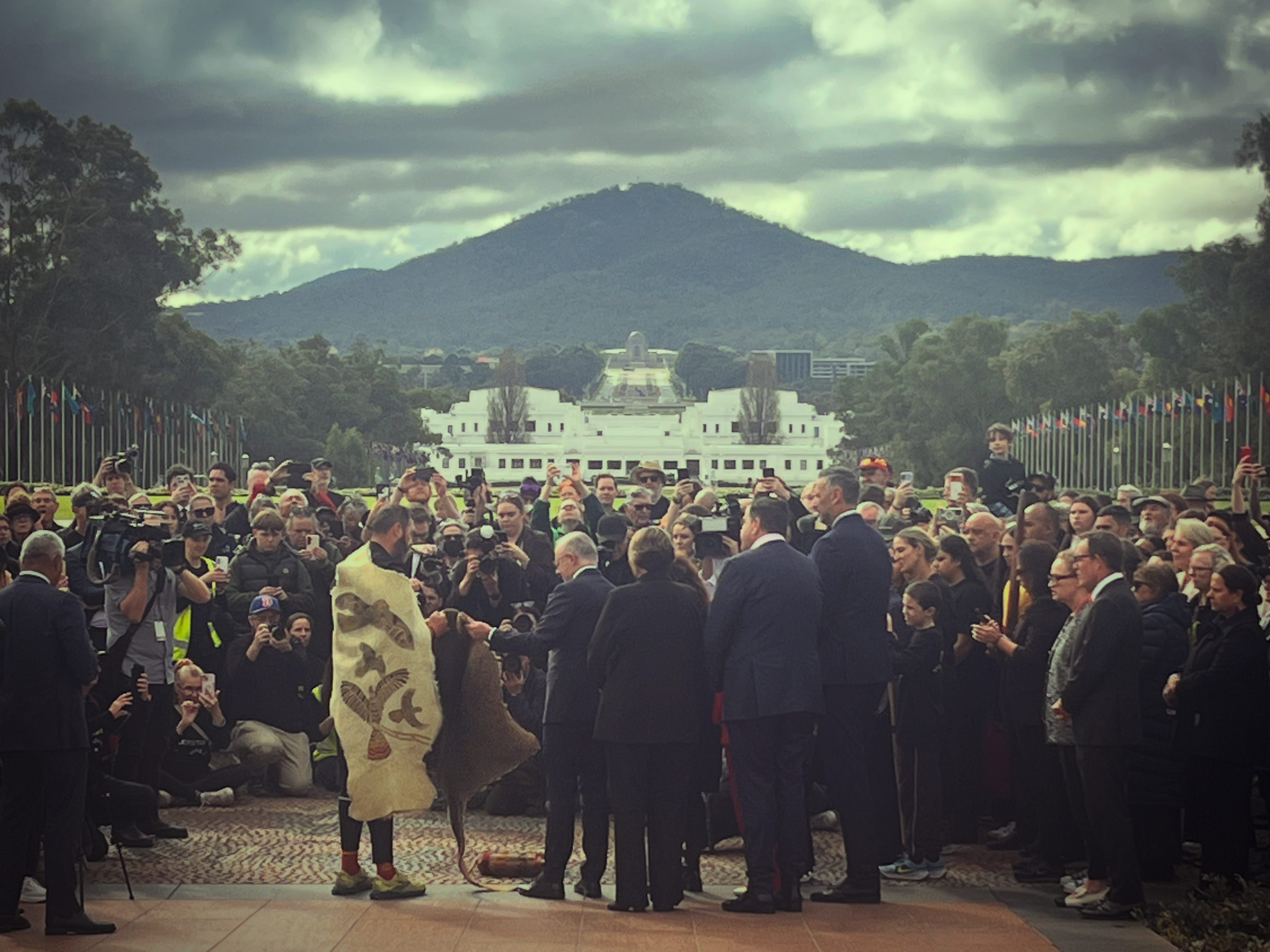
It was in this still late May morning setting that saw several hundred travellers quietly walk to the steps of parliament house to celebrate the ending of the Walk for Truth; the 900 plus kilometres walked by Kerrupmara/Gunditjmara, Boandik man Travis Lovett from Melbourne/Narrm to the nation’s capital.
As gruelling as it must have been for him, for me it was refreshing to be at another quiet ceremony surrounded by familiar and kind faces from my life. People that have dedicated their lives to supporting their own communities, advocating for our rights as First Peoples and educating the broader public about our culture and our plight; not through recrimination, but in the hope that what comes next, might just be better for all of us, one way or another.
Probably like most of us, I have been mildly exhausted recently. Even so, the feeling from that morning rested within me in the days that followed. No profound revelations ensued; no prophecy arose. Just a sense of centeredness and the gratitude of knowing that despite the catastrophe that was the lived experience of the referendum, our people are trying other paths forward in spite of it all and for the good of all. The motivation within, the long train towards justice battered but never derailed.
In a time of profound universal tumult, there’s more political movement within First Nation affairs than since the referendum. Competing, but ultimately, co-inhabiting ideas on representation and reform for our people, on changing the national conversation and forming a dialogue where we have a say over our own affairs are afoot. Add to this perhaps the most urgent action of all, the vital need to combat and organise against the rise of the populist right.
I lean in with open ears and an open heart for these debates within our movement; as long as they are held respectfully and with reason. But one thing I do know is that we must get our act together quickly as we are in an existential fight for the soul of the country. It’s time to decide what kind of nation we want to be.
*
Just what’s at stake hit my eyeballs with a thud as astonishment swept through my social feeds with a video so toxically racist it was difficult to comprehend its audacity, even here in Trump’s 2026.
What I tried to ignore was footage from a wannabe comedian that extinguished, with barrel of cold water the warm inner glow within me this week. Another reminder that not only have forces of hatred unleashed in this country, but they are also becoming normalised. And once norms are established in a society, they are very difficult to break.
The video from earlier this week was from a self-desrcibed comedian from the Mornington Peninsula placed herself inside the familiar frame of SBS’s Insight, borrowing its watermark and format as a kind of borrowed legitimacy. In her version of events, she appears as a character she names “Aunty Lisa”, a woman who declares she has recently identified as Aboriginal.
What followed was not observation or satire so much as reduction. Words drawn from First Nations vernacular, including “blakfella”, are twisted and exaggerated for effect. A fur coat sits heavy on her shoulders. White paint is streaked across her face, gesturing towards the ceremonial use of ochre, but without ceremony, without context, without care.
By the final seconds of the clip, she reaches for a jerry can and raises it to her nose, playing out a reference that requires no translation. Petrol sniffing, an addiction that has scarred communities across this country, both Aboriginal and non-Aboriginal, is recast as shorthand, a visual punchline offered up for an easy laugh.
There’s a clear line from the referendum to now that has turbocharged this hatred, the cold-blooded punching down from the dominant; but that’s a story for another day.
*
While the video is lame and offensive, we all know now that what is about to happen going to be worse, as the video, and the comedian’s belligerence in refusing to see her own racism are going to feed the culture wars, replete with a social funding page now that her employer has sacked her. $25k raised so far at the time of writing of this.
It’s a story in a longer narrative that demonstrates that we are now at a point where racism, especially when it comes to Aboriginal people, has become a left/right issue. An exemplifier that so many of us have fallen far from our own humanity, that what was once seen as a racist trope by a lame comedian, is now up for debate, and that every half-concocted theorist with their bended take on the world will use the First People of this land as content for their prosecutions. AND amidst it all, once again it will be up to Aboriginal people to explain, contextualise, educate, purge or forgive. To show the way through this by pressing forward again, as we must.
In a world of algorithms and the rewards they induce, Aboriginal people become the content, the fodder that feeds the machine that gives the gormless a sense of belonging, not within their own communities, but within curated chat rooms where consequence rarely stumbles across reality.
In this context, this world created by tech bros and exploited by narcissists, it becomes more and more difficult to hold serious conversations about serious things with serious people. While we would like to be talking about incarceration rates for Aboriginal people, or how Closing the Gap has abjectly failed or the deplorable living conditions in remote communities; we have to down tools and respond to some lame stunt someone posted on social media before it burns all of the oxygen from any important discussion that must be had.
To address this form of racism when it arises in the social media sphere is to risk becoming part of the sideshow itself. To not only be fodder for the algorithms but to feed them as well. Something bouncing about in the back of my mind as I write this. But what other choice is there even though it’s exhausting and it feels like taking one step back for every step taken forward. But it has to be tackled and in real time, because these racist posts and the storm around them must be addressed in real time because they do harm in real time.
The challenge is to not let these small minded idiocies distract us from the tasks at hand. But that doesn’t mean it isn’t exhausting. There is a cost, but who else is willing to pay the price?
It’s in times like this, when I’m searching for solace that I return to the quiet moments. The signing of the treaty, the passionate yet convivial exchanges I have with our leaders, the warm smiles of seeing fellow travellers for the cause in faraway places, that I then remember so much of it is noise, so much of it is static in a moving world.
I had the pleasure of spending a little time with senior Yorta Yorta elder Uncle Wayne Atkinson. I asked him, after his lifetime of effort how to improve the lot of our people. To instigate a revolution in dire times and when the circumstances require. His answer was as frustrating as it was inspiring; we just need to “keep chipping away.”
History shows that we are a patient and pragmatic people, and that we have our own fringes, the radical and the conservative.
The real challenge for us now is to unite and push on.