The Grammar of Comfort
Thirty years on, the mainstream John Howard defined continues to frame the nation’s limits.

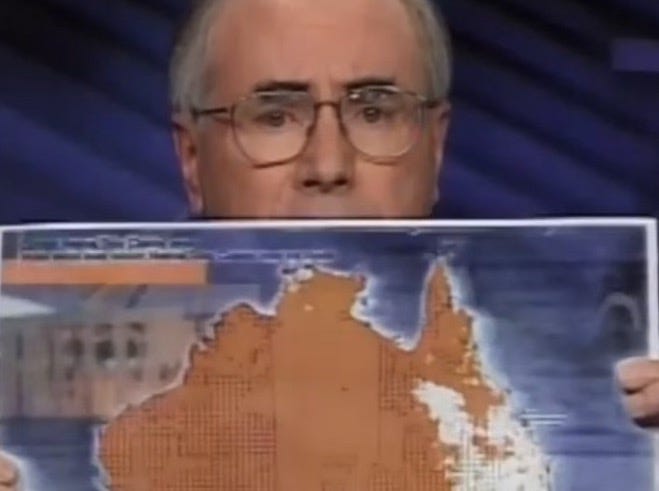
I have been thinking a great deal about John Howard recently, about his largely unwelcome return to the public gaze after the Bondi terror attack, about the fact that next week marks thirty years since he was first elected to office, and about the three part series I have been working on for 7am to mark that anniversary, all of which has unsettled memories I had half packed away and brought old recognitions back to the surface.
In March 1996 I was living in Euroa, a town that could feel expansive and tightly held at once, where the sky opened wide to the west across generous flood lands and Balmattum Hill kept its quiet watch to the east, where the Seven and Castle creeks gently rolled down from the Strathbogie Ranges toward their meeting with the Goulburn across the flats of Shepparton, and where the landscape seemed to promise permanence even as the social world remained narrow, watchful and alert to who belonged and who did not.
Dad called it small town syndrome, that steady calibration of status and familiarity, that quiet accounting of surnames and allegiances. So when the town was forced to think beyond itself, like when Howard defeated Paul Keating and ended thirteen years of Labor rule it did not feel like a change of government so much as a restoration, a correction spoken of around kitchen tables and in hardware stores as though something wayward had been set right and the country returned to its proper alignment.
I could feel what was happening beneath the surface, shaped by Dad’s natural social justice bent and by an early conviction about what was just. Passed down to me through me through DNA as much by experience.
Howard came to office at a moment of cultural anxiety, after Keating had asked Australians to reconsider themselves through reconciliation, through the possibility of a republic, through an orientation toward Asia, where we sit, rather than Britain, invitations that felt to some like an opening window and to others like accusation, and Howard understood that discomfort intimately enough to wrap himself around it. Speaking of the mainstream and of battlers, of people lectured by elites, assuring them that their instincts were sound, their resentments reasonable, their version of the country not merely legitimate but central.
In towns like mine that reassurance landed heavily. Settling into the grain of daily life, where talkback radio crackled in kitchens and workshops and grievance were repackaged as common sense. Where political correctness (wokeness) was said to have gone too far, where Aboriginal people were accused of asking too much and the past was declared settled, where farmers struggled and small businesses tightened belts even while the mining boom swelled the national coffers, promising reward for those deemed hardworking and compliant. Manor from heaven for John Howard.
Only a few years earlier the High Court’s Mabo decision had overturned the fiction of terra nullius, a legal recognition that the land had never been empty and that sovereignty had never been ceded, and in 1996 Wik confirmed that native title could coexist with pastoral leases, a clarification that in another register might have signalled maturity and shared ground.
In towns like mine, however, coexistence was heard as encroachment, not because the rulings demanded dispossession but because they unsettled a story long told about ownership and certainty, and reconciliation, which might have been embraced as moral reckoning, was reframed instead as threat. What was, in legal terms, a recognition of layered rights became, in cultural terms, a zero sum contest in which acknowledgement for one group was felt as diminishment for another, and the emotional terrain shifted accordingly.
It was in that atmosphere of unsettled certainty, where recognition was recast as loss and complexity flattened into grievance, that Pauline Hanson rose to warn that Australia was being swamped by Asians and that Aboriginal people received special treatment, language that many publicly denounced yet privately recognised as an articulation of anxieties already circulating beneath the surface.
The shock in which her maiden speech was met did not signal the arrival of something entirely new so much as the removal of a filter, and when Howard declined to condemn her outright, choosing instead to defend her right to free speech, the effect was not principled distance but quiet sanction, a recalibration of the permissible that widened the corridor of expression and altered the national tone with startling speed.
Free speech, once imagined as shelter for the exposed, began to function as armour for the secure, and civility came to mean swallowing objection so that prejudice might pass unchallenged across dinner tables and through radio waves, while attempts to describe racism as structural and historical were dismissed as indulgent abstractions from people. A narrowing of moral vocabulary that felt neighbourly in tone even as it redrew the boundaries of belonging. The terms of what is us and what is them, was being rewritten in suburban prose.
Howard was masterful in that neighbourly cadence, returning often to mutual obligation, a phrase polished to moral sheen and delivered with the calm authority of common sense, yet beneath it lay a reshaping of sympathy in which the safety net became a proving ground and welfare a test of character, the unemployed summoned to demonstrate virtue amid dispossession and the precarious expected to perform gratitude under scrutiny, dependency recast as personal defect rather than structural outcome.
That vocabulary thickened over time into watchfulness and suspicion, until entire communities felt the steady gaze of the state assessing worthiness and compliance, and what would later emerge as robodebt appeared not as an outlier but as logical extension, the bureaucratic expression of a moral hierarchy already normalised.
In his final year in power, before losing his own seat of Bennelong, Howard’s instinct to divide and reap the electoral reward from the greater broken pieces, he launched the Northern Territory Intervention. It stood as the clearest embodiment of his opportunistic mindset. Announced as urgent protection yet suspending the Racial Discrimination Act, quarantining welfare and sending police and military personnel into Aboriginal communities, measures described as decisive but experienced by the First Peoples of the NT as occupation, establishing the precedent that rights could be set aside in the name of care, a precedent whose logic continues to echo.
It is tempting to confine the Howard years neatly between the promise of the early 1990s and the volatility that followed, yet their imprint persists in tone and reflex, because Howard’s great political skill was not spectacle but endurance, an advancement by degrees in which institutions were tuned rather than overturned, judges appointed, the public service recalibrated, the pitch of national debate lowered and steadied until repetition made assertion sound like truth.
That repetition affirmed an Australia comfortable with inequality, suspicious of apology and wary of complexity, an Australia inclined to scoff at treaty, to roll its eyes at truth telling, to treat Welcome to Country as excess rather than generosity, cultivating a politics in which to be heard one first had to demonstrate restraint, anger framed as disqualifying rather than instructive.
Of course, Howard did not invent the deeper currents of racism and inequality that predate federation itself, yet he furnished them with a late twentieth century grammar that allowed people to feel embattled while occupying the centre, blissfully ignorant of their own privilege. Continuing to insist the country was relaxed and comfortable even as it tightened around the younger generation to constrain them, despite their ambition, to a world out of reach.
While created Australia in his own image, there were pockets of resistance in those years, though rarely from where it was most required, and an Opposition that often conceded rhetorical ground before the argument had properly begun left much of Howard’s settlement intact, ensuring that subsequent governments operated within boundaries already drawn by Howard himself.
We remain, in significant respects, within that architecture, and while governments have come and gone and tones have softened or sharpened, the underlying settlement has held, shaping responses to borders, apology and justice in ways that feel instinctive rather than chosen.
In 2026, Anthony Albanese governs with a parliamentary majority that matches that of Howard’s thirty years before. He is positioned as the first prime minister since 2007 with a genuine opportunity to articulate a legacy distinct from the inheritance he received, to tilt the country toward something braver and more expansive; yet, so far, the recalibration has been careful, managerial and restrained, where there might have been a widening of the national imagination there has been caution, where there might have been a moral argument equal to the moment there has been procedural competence, and in the wake of the Voice’s defeat what was required was not only respectful sorrow but a contestation of the story told about history and the lessons from it, a willingness to reshape risk rather than merely manage it, to enlarge the room rather than simply read it.
Until such a reckoning occurs, until the government is prepared to unsettle the settlement it inherited and test the limits of the comfort it so carefully maintains, we remain within the architecture Howard so meticulously constructed, mistaking stability for transformation and caution for courage.
Anniversaries demand more than memory; they demand reckoning, an appraisal of the structures we continue to inhabit and the reflexes we have mistaken for inevitabilities. Three decades on the question is not whether John Howard was liked or loathed but whether we are prepared to step beyond the country he made comfortable and risk becoming something larger than the outline he left behind.
7am’s three-part series The Howard Effect airs on Monday. It features political commentator and author Amy Remeikis who has written a fab book on the Howard years that you can purchase here.

