
The Narrowing of Who Counts
How culture war politics is reshaping immigration, belonging, and multicultural Australia.

Over the past decade, the Australian political landscape has shifted in tone and temperament. Debates that once felt settled have reopened. The language of politics has hardened, more insistent about identity and allegiance, more comfortable drawing lines than building bridges real or metaphorical. Themes that once flickered at the margins now shape campaigns, headlines, and leadership contests, setting the emotional weather of public life.
Immigration and multiculturalism feel increasingly fragile in that environment. What once seemed a releatively settled part of the Australian story now feels contested again. Questions about who belongs are no longer fringe. They sit at the centre of our politics, influencing how parties organise themselves and how leaders frame the future.
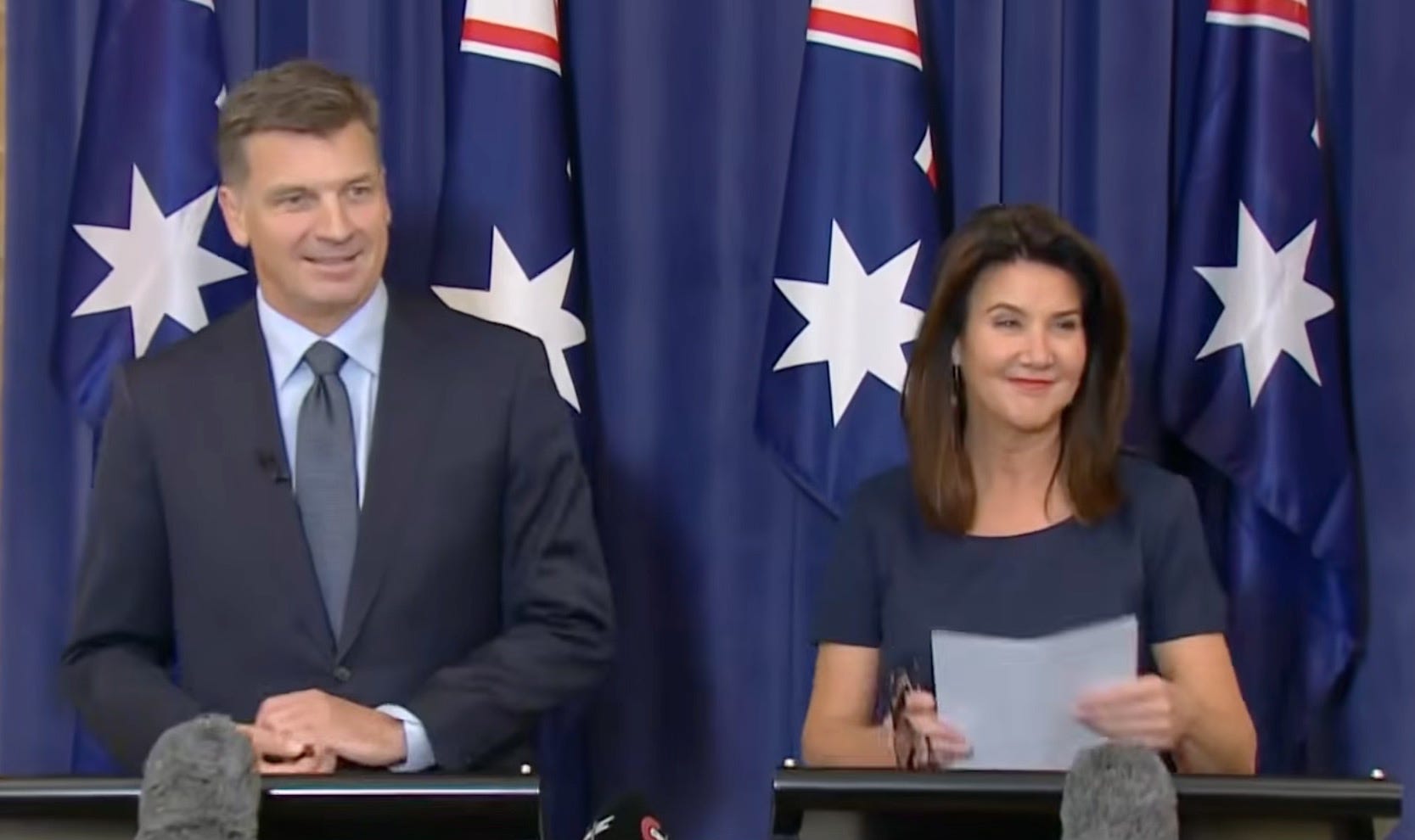
At his first press conference as Liberal leader, Angus Taylor stood before six Australian flags, a wall of blue, red and white; framing his promise to fight for the nation. The staging was deliberate. It appealed to a confident strain of nationalism and placed him squarely at its centre. The message was clear: this is about identity as much as policy, about who we imagine ourselves to be.
Australia does not develop these frames in isolation. The right here borrows from sharper versions of the same politics in the United States and the United Kingdom, where culture war rhetoric is tested before travelling across oceans like a virus, aided by elements of our own media that amplify and legitimise it.
Ideas about border crises, civilisational decline, and threats to national identity cross quickly and take root easily. In the transfer, nuance is lost. Communities are flattened into symbols. Internal disagreements are pushed aside. Plurality is compressed into stereotype, making it easier to advance agendas about immigration, religion, and belonging.
Take the Aboriginal community, my community, where so much of this politics is tested. We are so often spoken about as though it were singular, with one voice and one settled will. That simplification does real work. When any of us are reduced to a single cohort, we become easier to shape into someone else’s argument. A uniform block is easier to praise or condemn than a living diverse people, a community in all its imperfection.
Of course in reality there are many nations, languages, histories, and political traditions; urban and remote lives; elders and young people; reformers and sceptics. There is disagreement and change, not as weakness but as political life. During moments such as the Voice referendum, selective voices were elevated as proof of unity or division, while the fuller debate was squeezed into a binary that suited the campaign and simplified the country’s conscience.
Once the caricature settles, the consequences follow. Difference is recast as disorder and debate as weakness. What resists easy control is simplified. Diversity is not abolished outright; it is trimmed back and reshaped into something more manageable, more compliant, more easily governed. That instinct now runs through the heart of the contemporary right.
As conservative politics has moved further right, parts of the mainstream media have moved with it. Angus Taylor’s first address as leader made that plain. He spoke of a party facing extinction, of the need to “change or die,” of restoring the standard of living and protecting the Australian way of life. He linked record immigration to pressure on housing and services, warned that borders had been open to people who “hate our way of life,” and argued that the door should be shut to those who do not subscribe to what he calls our core beliefs.
These themes are not simply about policy detail. They imagine the nation as culturally singular and under threat. Immigration and belonging are cast as front lines in a struggle over identity and cultural authority. A place where judeo christian values are often cited but rarely practices by those that preach it.

In this frame, immigration collapses into a question of loyalty and cultural fit. Defending Australian values “unapologetically” is sold as common sense. Beneath it lies a harder claim: that there is one legitimate way to live, and it can be defined, measured and enforced. Settlement gives way to compliance. Multiculturalism is recast not as a national success but as a failed experiment. The debate shifts from how we live together to who counts, and who must endlessly prove they belong. We need only look to the United States to see how this whitening of public life corrodes the very society it claims to protect.
It is on this ground that Hansonism finds oxygen. It advances a politics that makes citizenship feel conditional and belonging something to be performed, time and time again. In doing so it casts multiculturalism not as strength but as excess, something that has gone too far and must be corrected in the name of cohesion.
When One Nation’s Barnaby Joyce said that if migrants wanted Australia to resemble the “sh*thole” they came from they should “go back there,” he gave voice to a blunt version of that instinct. The insult compresses whole communities into a single image and redraws the boundary of who is welcome. Repeated often enough, language like this stops sounding extreme and starts sounding familiar. It creates a norm, a kind of safe harbour for deeper prejudice that no longer needs to disguise itself.
In that climate, prejudice is rebranded as plain speaking, as a “pub test”. In this intoxication communities are reduced from citizens, diverse within their own diversity, to threats to be managed or expelled. As the circle of legitimate voices tightens, division is not merely reflected, it is hardened, making a shared future harder and harder to imagine for the unimaginative with an agenda.
In his new role, Taylor will need to be far more careful, and far more oblique, than his blunt and curious predecessor, Tony Abbott. Appearing on 7.30 last night, Abbott, sounding nostalgic for another era, told host Sarah Ferguson: “I think there are serious concerns about multiculturalism that’s run off the rails.”
“I quite liked the way our immigration policy was run in the 50s, 60s and 70s,” he continued, “where there was an expectation of integration from day one and ultimately assimilation.”
The policy Abbott is pining for is none other than the White Australia Policy. It is the place he has always wanted to return to. A past dressed up as order and cohesion resulting in oppression, repression and depression.
If Taylor shares that instinct, he will understand that the route back to it cannot be argued plainly. It must be coded, softened, and sold as something else. As a saturated 16 mm rolling image of an old world that existed for some long ago.
So, let us call this moment for what it is, without code. For we have the luxury of plain speak, to be unambiguous about what we mean and what we see.
When immigration is framed as a civilisational threat, when “Australian values” are weaponised as a loyalty test, and when belonging hinges on conformity, the destination is clear. This is the logic and coded speak of white nationalism; laundered through the language of security, stability and so called common sense.
The signals are clear about who is imagined at the centre and who is pushed to the margins, about whose Australianness is assumed and whose is scrutinised. It’s our responsibility to recognise what is being attempted here, and to call it out.
If multicultural Australia is to endure, we must reject the narrowing of who counts as Australian and resist the idea that unity requires sameness. A confident nation does not tremble at difference within its own borders. It understands that argument, dissent and layered identities are proof of vitality, not decline. The pursuit of cultural purity does not fortify a country. It diminishes it.
If we know these things when they arrive in real time, then we can protect all that is wonderfully impure.
There’s a lot here that resonates. The tone has hardened. Identity is back at the centre. That shift is real. Like a lot of Australians, I'm from migrants, and I don’t treat questions of belonging as abstract. Most Australians are only a generation or two removed from being told, subtly or otherwise, to prove they fit.
Where I’d push this further is class and capital. When immigration is framed as the cause of housing stress or strained services, that’s not only culture war rhetoric. It’s also a redirection. It turns anger sideways.
Who benefits when working people argue about cultural fit instead of land supply, tax settings, wage suppression, or corporate profit margins? Who benefits when scarcity is personalised rather than governed?
If belonging is narrowing, we need to ask who gains from that narrowing. Division is rarely accidental. It’s often economically convenient. That’s the harder layer beneath the cultural one.
To spend just 30 seconds contemplating Taylor’s statement that there are people who have migrated to Australia that hate our way of life…don’t want to embrace Australia, and want the country to change for them, would surely throw up some questions.
A Services Australia webpage on migrating to Australia says that “Most people move to Australia to be with family, to work, or as a refugee.”
I’m clearly the kind of person who spends more than 30 seconds thinking about what politicians say. But too many Australians don’t spend time questioning, pulling apart the message in their own minds or in conversation with others. The partnership of the right-wing and msm delivers dopamine on tap, eroding civic thinking skills and inserting, what you’ve articulated so well, the flattening, stereotyping, othering, prejudiced, racist story that they will save the country from if only you’ll give them your vote.